An ingredient present at a tenth of its studied dose is decoration. The only way to evaluate a pre-workout is to compare what is on the label against the doses the research actually used.
Here are those numbers, and then what the evidence behind each one is really worth.
The reference doses
| Ingredient | Studied dose | Timing |
|---|---|---|
| Caffeine | 3–6 mg/kg body weight | 30–60 min before |
| Creatine monohydrate | 3–5 g | Daily, timing irrelevant |
| Beta-alanine | 3.2–6.4 g | Daily, builds over weeks |
| Citrulline malate | 6–8 g | 60 min before |
| Betaine | 2.5 g | Daily |
| Dietary nitrate (beet) | 6–8 mmol | 2–3 hours before |
| Sodium bicarbonate | 0.2–0.3 g/kg | 60–180 min before |
Reading a tub against that table
Take a typical pre-workout with a 6-gram “performance blend” listing ten ingredients. Citrulline alone needs 6 to 8 grams to work. The arithmetic tells you the answer before you read another word.
This is why the proprietary blend exists. It is not protecting a formula: ingredient lists are public and any competitor can have a product reverse-engineered for a few hundred dollars. It is concealing the ratio.
The practical rule: add up the studied doses of the ingredients you actually care about. If that total exceeds the blend’s stated weight, the product cannot contain effective amounts of all of them. This one piece of arithmetic disqualifies most of the category.
Caffeine is the only ingredient with a genuinely strong file
It works by blocking adenosine receptors in the central nervous system, which reduces perceived effort and pain and increases motor unit recruitment. The older “spares glycogen by burning fat” explanation has largely been abandoned.
The International Society of Sports Nutrition puts the effective range at 3 to 6mg per kilogram of body mass, taken around an hour before training, with a minimum effective dose possibly as low as 2mg/kg. There is also a useful ceiling: 9mg/kg produces side effects without additional benefit. In practical terms, 3 to 6mg/kg is 240 to 480mg for an 80kg person and 180 to 360mg for someone of 60kg. Hold those numbers against the label.
Now the part the marketing skips: the effect is small. An umbrella analysis of meta-analyses found a standardized effect of 0.18 for muscular strength across 1,628 participants and 0.30 for muscular endurance across 835. That is a real nudge that is reliably there, not a transformation. It is also worth saying that this literature is overwhelmingly male; the female data are thin.
The CYP1A2 genotype story does not hold up
You will have read that a variant in the CYP1A2 gene sorts people into fast and slow caffeine metabolisers, and that slow metabolisers get less benefit or are harmed. Genetic testing panels are sold on exactly this. It is the cleanest available example of a supplement-industry story collapsing under scrutiny.
A meta-analysis pooling 13 studies and 119 outcomes found the whole literature rests on 440 participants, of whom just 34 people worldwide carry the CC genotype that supposedly does badly. That is a sample size, not a fact.
Worse for the story: conflict of interest interacted specifically with that CC group, and after excluding studies with declared conflicts, no influence of genotype was seen at all. A separate 2024 review of 12 studies and 666 participants found caffeine improved cycling time trials only in one genotype group but found no effect on power or jumping in any group: an incoherent pattern if genotype were really sorting people biologically.
So do not buy the test. The practical advice is the boring one: find your tolerance empirically. If 200mg at 4pm has you awake at midnight, your sensible dose is lower, and you did not need a cheek swab to learn it.
Does tolerance mean you should cycle off?
Present both sides, because the evidence genuinely splits.
The meta-analytic evidence says habituation barely matters: a pooled analysis of 60 studies and 1,137 participants found habitual intake did not significantly moderate the effect size, and a trial comparing low and high habitual users found both improved by essentially the same amount.
The experimental manipulations say it matters somewhat. Twenty consecutive days of 3mg/kg produced large effects in the first four days, diminishing but still present at day twenty: progressive, incomplete tolerance. A nine-week study found chronic use reduced but did not eliminate the benefit, that doubling the dose compensated only in trained users, and that an eleven-day withdrawal restored the effect.
The honest line: cycling is not necessary for most people. If you do want to reset, the only direct experimental support is around a week and a half off. “Cycle every six to eight weeks” is a gym rule of thumb that no trial has tested.
Beta-alanine works, but almost never as it is sold
Beta-alanine is the rate-limiting precursor to carnosine, an intracellular pH buffer. The critical fact, which invalidates the premise of putting it in a once-before-training scoop: the acute dose does nothing. The benefit comes from carnosine accumulated over weeks of daily intake.
The dosing that has been shown to work is 3 to 6 grams a day, split into roughly 0.8 to 1.6 gram doses, for at least four weeks. In a 2024 analysis of 18 randomized trials in 331 trained men, only the high-dose band of 5.6 to 6.4 g/day reached significance. Low and medium doses were ineffective.
Then there is the question of what it helps with, which is the most misrepresented thing about it. The benefit concentrates on high-intensity efforts lasting roughly four to ten minutes. Efforts under a minute showed no significant improvement. Beta-alanine helps the 800 meters, the 2km row, a brutal conditioning block. It does not help a heavy set of five. Most people buying pre-workout for lifting are buying beta-alanine for an activity it has never been shown to improve.
The magnitude, when it does apply, is around 2 to 3% in recreational athletes and under 1% in elite ones.
There is also a striking saturation finding. Modeling of individual and pooled data put the dose producing half the maximum effect at roughly 377 grams cumulative, and found that cumulative doses of 1,000 to 1,500 grams still gave only a 68 to 85% probability of reaching 70% of the maximum. Essentially everyone responds, and almost nobody loads enough.
The tingle is not the point. Paresthesia (the flush and prickle in the face and hands) appears above roughly 800mg in a single serving. It is harmless and transient, and it is a side effect, not a signal of efficacy. It is also, more or less, why beta-alanine is in pre-workouts: it makes a product feel like it did something within fifteen minutes. Sustained-release formulations abolish the tingle without losing the effect, which tells you what the tingle is worth.
One more useful number: carnosine takes roughly fourteen to fifteen weeks to wash out. Someone who has genuinely loaded can skip the pre-workout for three months and lose nothing.
Citrulline: the pump does not reliably become performance
Citrulline is one of the better-supported non-caffeine ingredients, and looking at how modest “better-supported” is here is instructive.
A 2021 meta-analysis of 8 double-blind trials found a small significant effect (about three extra reps), but neither the upper- nor lower-body subgroup was significant on its own, removing a single study pushed the whole result to the edge of significance, and a correction for publication bias made it non-significant.
The 2026 update pooled 30 randomized trials, 644 participants and 138 effect sizes. Overall effect: g = 0.16. Statistical power: 8%. Chronic use: non-significant. Aerobic and anaerobic subgroup effects attenuated after removing outliers. Certainty of evidence: low to very low. The authors’ own summary was that current evidence remains limited and uncertain.
Two independent meta-analyses five years apart both find the effect evaporates when you poke it.
On the pump specifically, be clear with yourself: vasodilation and transient cell swelling are real and measurable, and feeling a pump is a sensory experience rather than a performance outcome. The 2026 analysis found no significant effect on rating of perceived exertion either, so it does not even reliably make the set feel easier.
A labeling trap worth knowing: “citrulline malate 6g” and “L-citrulline 6g” are not the same dose of citrulline. Citrulline malate is typically a 1:1 blend, so 6g of it is around 3.5g of citrulline. Labels rarely specify the ratio.
Betaine, and the rest of the second tier
Betaine is the strongest of a weak group. A 2024 analysis of 17 randomized trials and 317 participants, at doses of 2 to 6 grams a day, found a pooled strength effect of 0.47, but significant for lower body only, with no effect on cycling sprint power, bench press throw or muscular endurance. Heterogeneity between trials was very high and only three studies included women.
Taurine, tyrosine and theanine belong in the same tier or below it. They are not dangerous and they are not doing much, and a product that leans on them is leaning on the weakest part of its own evidence base.
BCAAs are the clearest “why is this here” case in the category. If you consume adequate whey protein, you have already taken them: whey is roughly a quarter branched-chain amino acids by weight. Adding a few grams separately to a pre-workout adds cost and label length.
Timing, which is more variable than people assume
Two of the table’s entries are not “pre-workout” ingredients at all in the usual sense.
Creatine and beta-alanine work by accumulation. Their effect depends on tissue saturation built over weeks of daily intake, not on the dose taken before a session. Take them daily, including on rest days. Taking them only before training substantially undercuts both.
Nitrate needs two to three hours, not thirty minutes, because it has to be converted by oral bacteria and then to nitric oxide. Taken immediately before training it is too early in that chain to help. Worth knowing: antibacterial mouthwash interrupts the conversion and blunts the effect entirely.
What a defensible pre-workout looks like
- All ingredients disclosed with individual amounts.
- Caffeine stated in milligrams, not implied by “energy blend.”
- The ingredients that matter present at or near their studied doses, rather than twelve at token levels.
- No novel stimulants with short safety records.
- Third-party tested, which matters more here than almost anywhere: stimulant products have a long history of undeclared ingredients.
And a stimulant-free option available for evening training, which is when most people actually train. Caffeine’s half-life of roughly five to six hours means a 300mg dose at 6pm still has around 150mg circulating at midnight, and sleep is a larger lever on your training than any pre-workout in the shop.
If you want the fuller argument about whether to take one at all, we have written that separately.
Related reading
- Should You Take a Pre-Workout Supplement?
- Prefuel: What Is In It and How to Get Value From It
- Sleep, Appetite and Body Composition: The Overlooked Variable
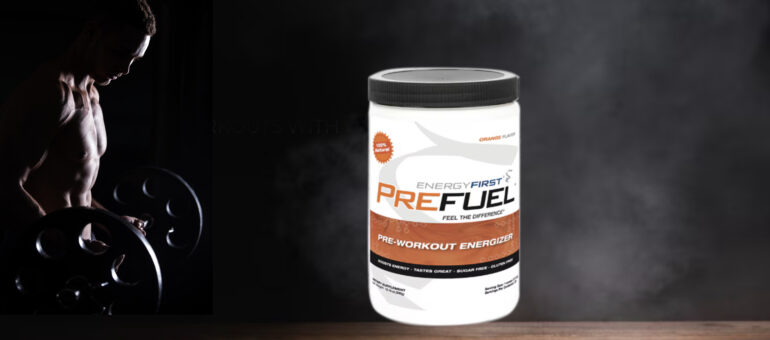
Prefuel is a sugar-free, 10-calorie pre-workout with amino acid, creatine and adaptogen blends, and an energy blend of L-tyrosine, L-carnitine, green tea and green coffee bean extracts. For the full effect of creatine, take 3 to 5 g a day on its own.
About the Author